
Current Federal Funds Rate
4.00%
Current Prime Rate
7.00%

How are B&I interest rates determined?
USDA B&I loan interest rates are pegged to the prime rate, with most falling in the range of prime + 1.0% to prime + 3.0%. However, the specific rate is negotiated between borrower and lender, and the rate a borrower receives depends on several factors, such as the loan’s risk profile, the strength of the borrower’s financials, the collateral, and the lender’s own appetite for the deal. A well-matched lender – one who is actively seeking B&I loans and sees your deal as a strong fit – is more likely to offer a competitive rate, which is a big part of why working with the right lender is so important.

What is the prime rate?
The prime rate is a baseline interest rate that banks use as a starting point for lending. It’s set by individual banks but moves in lockstep with the federal funds rate (the rate the Federal Reserve uses to influence the economy). In practice, the prime rate sits three percentage points above the federal funds rate. When the Fed raises or lowers its rate, the prime rate follows. With the current federal funds rate at 4.0%, the prime rate sits at 7.0%.

What role does the prime rate play in USDA B&I lending?
B&I loan rates are expressed as a spread above the prime rate. For example, ‘Prime + 2.0’ means the borrower’s rate is the current prime rate plus 2 percentage points. At today’s prime rate of 7.0%, a loan at Prime + 2.0 would carry an interest rate of 9.0%. The size of that spread reflects how the lender views the loan’s risk. A strong borrower with solid cash flow and good collateral will land closer to Prime + 1.0, while a deal with more risk factors might be closer to Prime + 3.0. Spreads are set in quarter-point increments (1.0, 1.25, 1.50, and so on).



Should I get a fixed or a variable rate loan?
B&I borrowers can choose between variable and fixed rate structures. A variable rate moves with the prime rate: when the Fed cuts rates, your payment goes down, and vice versa. A fixed rate locks in your rate for a set period, most commonly five years, after which it typically converts to variable.
Fixed rates can be higher or lower than variable rates due to the lender pricing in their prediction on rate movement over the fixed period. Whether a higher rate is worth paying depends on where you think rates are headed. In a declining rate environment like the current one, variable rates usually have an advantage, as your payments would decrease as the Fed cuts rates. In a rising rate environment, a fixed rate provides stability and predictability.
There’s no single right answer. The best choice depends on your business’s sensitivity to payment changes, your outlook on rates, and what the lender is willing to offer.

Would every lender give me the same interest rate?
No. Two lenders looking at the exact same loan can offer quite different rates. One lender may see the deal as a strong fit for their portfolio and price it aggressively. Another may be less familiar with the industry or region and add a risk premium. This is a major reason why the lender you move forward with matters, and why settling for the first lender you find can cost you real money over the life of the loan.

Prime Rate Recent History
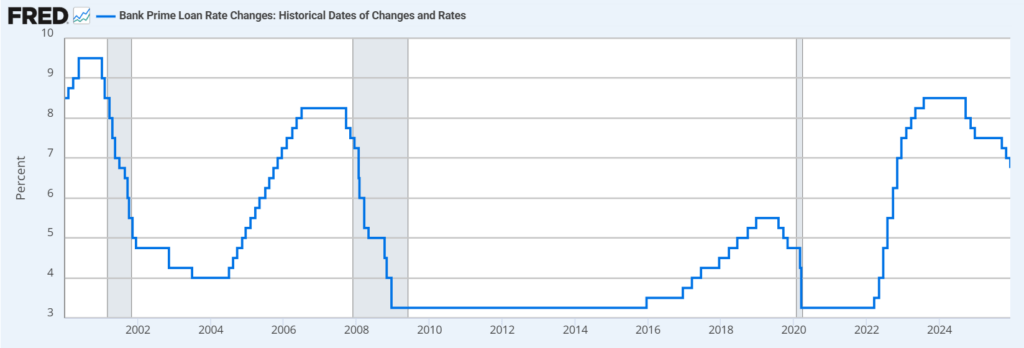
The prime rate is near its highest point in over two decades, which understandably gives borrowers pause. But the trajectory has shifted, with the Fed starting to cut rates, and most forecasts expect further reductions. For B&I borrowers, this is a favorable setup. If you lock in a variable rate loan now, your payments should decrease over time as the prime rate comes down.
It’s also worth putting the current rate in context. Rates at this level are not historically unusual: for example, the prime rate was above 8% for most of the 2000s. What was unusual was the near-zero rate environment from 2009 to 2015 and again during 2020–2022. That prolonged period of cheap money made normal rates feel high by comparison.
If your business’s cash flow supports the loan at today’s rates, that’s good. But make sure cash flow will still support the loan payment if rates rise. What seems like a good financial decision today may turn into a problem if you’re not careful.